
Walton County Court Records After a Jail Arrest
A Walton County arrest sets off a chain that ends in a court record. After booking, the case goes to the Office of the State Attorney for the First Judicial Circuit, led by State Attorney Ginger Bowden Madden. The prosecutor decides whether to file charges, and which ones. When charges are filed, the Walton County Clerk of Courts opens the official case file. That file is the court record: the case number, the charges, the filings, the court dates, and the disposition. The jail roster can hint at a court date, but it is not the formal record.
It helps to keep the two sides apart. The arrest and booking side lives with the sheriff, where you can read the booking through jail inmate records and see a booking photo through jail roster mugshots. The court record side lives with the clerk and the prosecutor, and it carries the charges that actually move a case. Booking charges and filed charges are not always the same, because a prosecutor can change them. So a complete picture after an arrest needs both the custody record and the court record.
How to Find Walton County Court Records After an Arrest
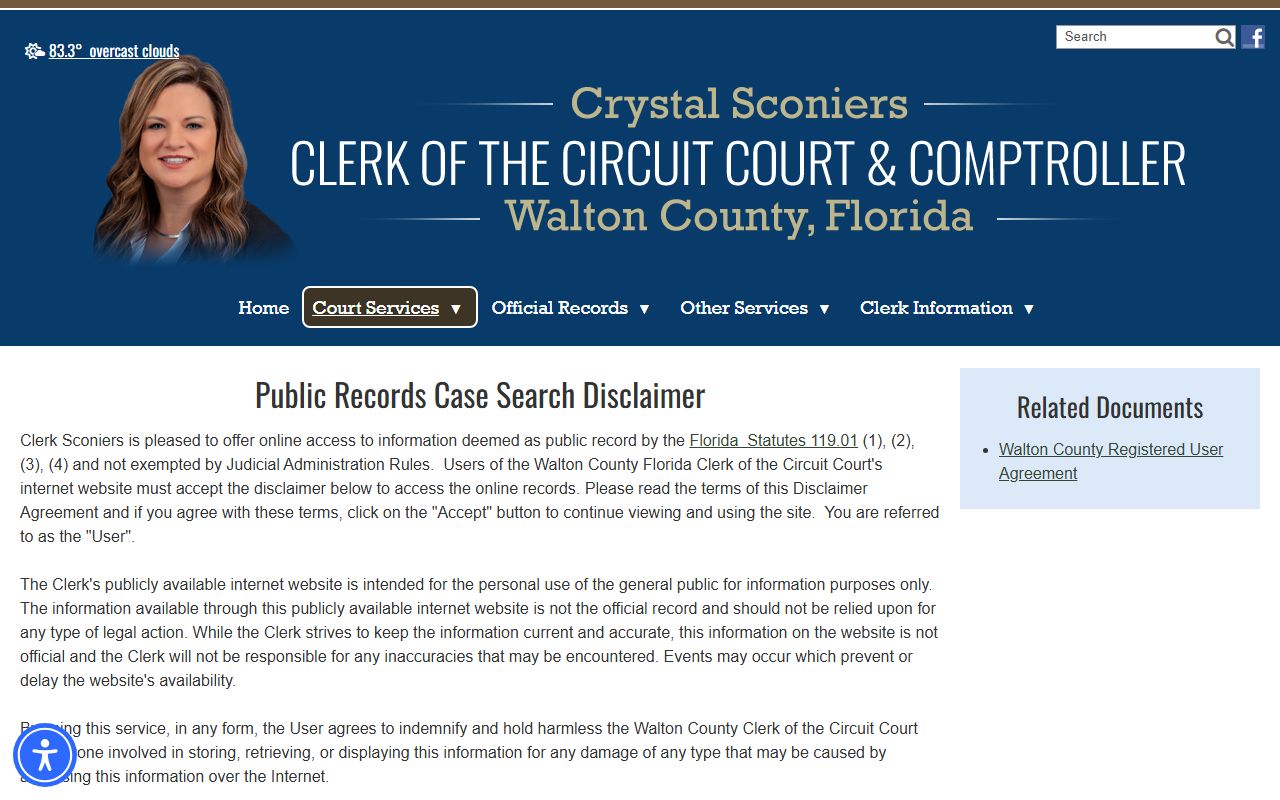
The clerk runs the public case search for Walton County. Charges and charge status show up there once the prosecutor files. The arrest and booking detail stays on the jail roster, so use both when you trace a case. The clerk's search page explains the access types and the disclaimer, on the Walton Clerk court records search.
The clerk's records search routes into the statewide public access portal, where you choose a search mode and enter a name or case number. The steps below match that flow.
- Open the Walton County OCRS case search portal.
- Choose public access, then search by defendant name or case number.
- Open the case and read the charge list, court dates, and events.
- Check each charge's code, level, and current status.
Name format is last name first, and the clerk caps a date-filed range at seven days, so a name search is often easier than a date search. For a statewide criminal history rather than a single case, the state police run that process under Florida law, separate from the county case index.
The portal offers more than one access level. Public anonymous access works for general case lookups, while attorney, registered, and party access need a login and can open documents the public view does not. Criminal cases break into a few court types, marked CF for felony, MM for misdemeanor, CT for criminal traffic, and CO or MO for ordinance matters. Case numbers can look long, while a jail docket number may be shorter, so the two formats will not always match. When a charge is sealed, confidential, or juvenile, the public search may show nothing even though an arrest took place.
How Charges Get Filed After an Arrest: Complaint, Information, and Indictment
From arrest to court record, the turning point is the charging document. Booking happens at the jail. The court charge begins when the prosecutor files. In Florida, most felonies are charged by an information that the prosecutor files. Some serious felonies go to a grand jury, which returns an indictment. A complaint or sworn arrest affidavit can start a misdemeanor matter. Each path opens the case the clerk then tracks.
| Complaint | Information | Indictment | |
|---|---|---|---|
| Filed By | Officer / Prosecutor | State Attorney | Grand Jury |
| Common For | Misdemeanors | Many felonies | Serious felonies |
| Starts | The case | The case | The case |
The Office of the State Attorney for the First Judicial Circuit handles this review for Walton County. Its homepage names the elected prosecutor and the circuit it covers, on the First Judicial Circuit State Attorney site.
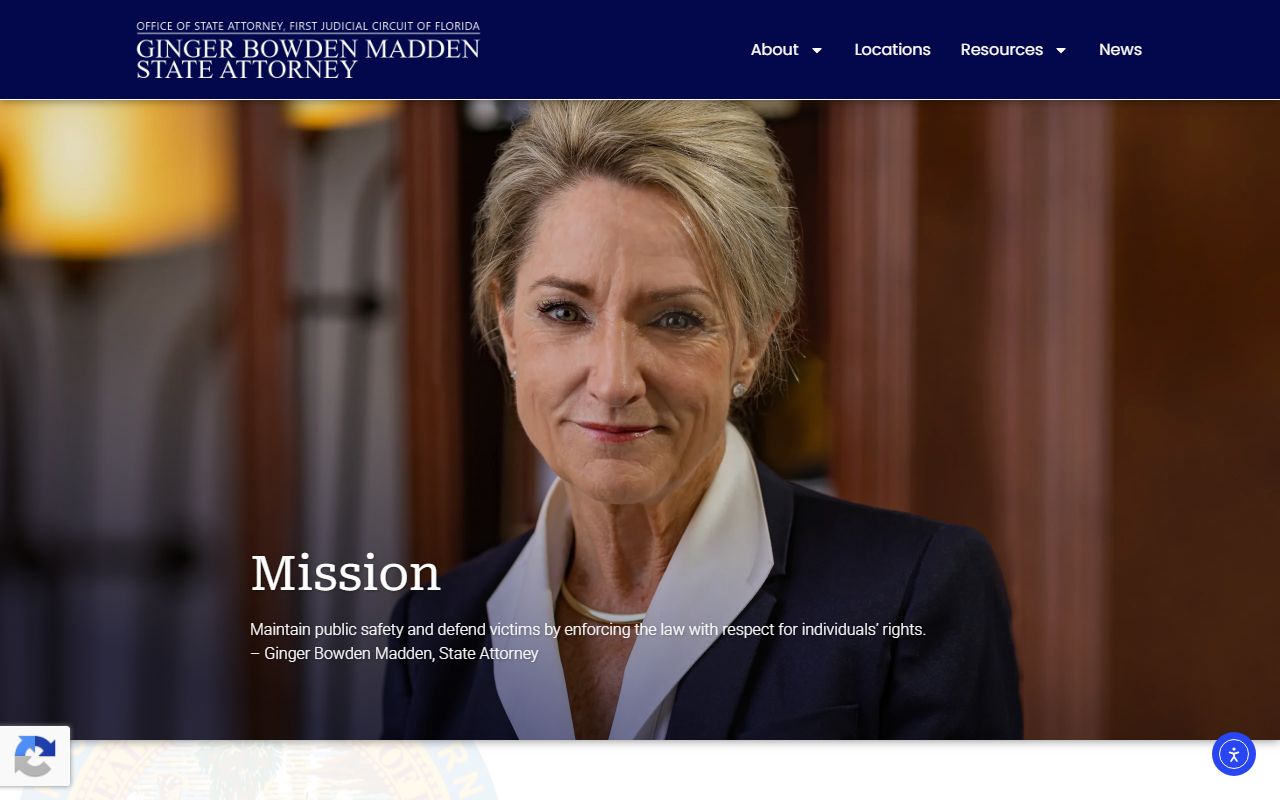
The circuit covers Escambia, Okaloosa, Santa Rosa, and Walton counties, and the main office is in Pensacola. Local Walton staff use 850-892-8080 extensions, while the elected prosecutor leads the whole circuit.
Charge Status in Court Records After an Arrest
Charges shift as a case moves. A prosecutor can amend, reduce, add, drop, or decline a charge. So the booking charges on the jail roster can differ from the charges in the court record. Reading the status on each charge is how you tell where a case stands. The table defines the common labels.
| Status | What It Means |
|---|---|
| Pending | The charge is filed and the case is still open. |
| Amended / Reduced | The prosecutor changed the charge after filing. |
| Dismissed | The charge was dropped and will not move forward. |
| Nolle Prosequi | The prosecutor chose not to pursue the charge. |
Note: A roster charge row may list a docket number and a court field, but the formal docket should still be confirmed in the clerk's case search, which is the official record.
Bond and Release After an Arrest
Bond usually comes up at the first appearance, soon after booking. A Florida judge weighs public safety, the person's ties to the area, the offense, and prior history when setting release. Bond can be cash, a surety bond through a licensed agent, or release on recognizance. A hold or detainer can keep someone in custody even when a bond is posted. The sheriff's bail page lays out who may post a bond and the approved-bondsman rules, on the WCSO bail bonds page.
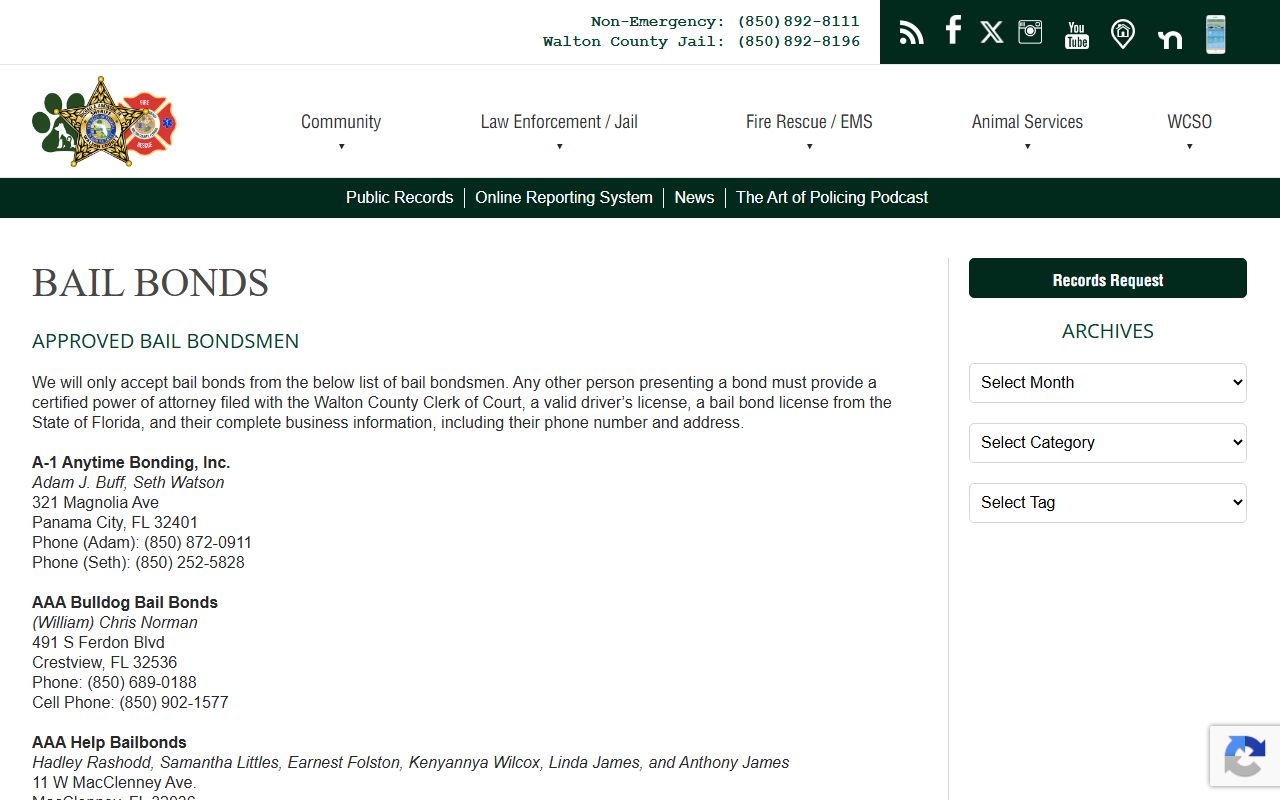
An online cash-bond service is also listed, and the caller is told to specify Walton County Jail, Florida. The table sums up the main bond types.
| Bond Type | How It Works |
|---|---|
| Cash Bond | Paid in full through an approved jail or court channel. |
| Surety Bond | Posted by a licensed bail agent using a power of attorney. |
| PR / Own Recognizance | Release without money based on the court's terms. |
| No-Bond Hold | A court order or outside hold blocks release. |
Warrants That Lead to an Arrest
Many arrests start with a warrant. A judge can issue an arrest warrant when a complaint is made and probable cause is found, and the law also lists when an arrest can happen without a warrant. A bench warrant or capias often follows a missed court date. Walton County has no standalone public warrant-search website that the research could confirm. The sheriff's mobile app advertises arrest and active-warrant updates, and warrant questions can go to the jail line at (850) 892-8196 or to jail@waltonso.org. The clerk's case index may also show warrant-related events such as a capias or a failure-to-appear entry.
A warrant turns into a court record through the same path as any arrest. An officer serves the warrant or capias and makes the arrest. The person is taken to the Walton County Jail and booked, which creates the roster entry. The court file then tracks the charge, the bond, and the next court date. If a warrant is a surprise, the safest move is to confirm it with the court or an attorney before appearing, since some warrants carry a hold that affects release.
Charges vs. Convictions
An arrest and a charge are accusations, not proof of guilt. A conviction comes only after a plea or a verdict. Both a charge and a conviction are public, but they mean very different things. Reading a court record with that gap in mind prevents a common error.
| Charge | Conviction | |
|---|---|---|
| Stage | Accusation | Verdict or plea |
| Burden of Proof | Probable cause | Beyond a reasonable doubt |
| Public Record | Yes | Yes |
Sealed vs. Expunged Arrest Records
Florida law lets some people seal or expunge a qualifying record after an arrest. Sealing hides the record from public view, while expunction goes further and has the record treated as if it never existed. Eligibility is set by statute and depends on the charge and the outcome. A dismissal or an eligible disposition is often the starting point. The table shows the difference.
| Sealed | Expunged | |
|---|---|---|
| Visibility | Hidden from public view | Destroyed or treated as never existing |
| Law Enforcement | Limited access | Very limited access |
| Florida Statute | Fla. Stat. § 943.059 | Fla. Stat. § 943.0585 |
Background Check Considerations
A casual court-record lookup is not the same as a regulated background check. Formal screening for jobs, housing, or credit must follow the federal Fair Credit Reporting Act and use a licensed provider. The clerk's index and a sheriff's local check are public-record tools, not consumer reports. The sheriff also notes that a local background check only reflects Walton County arrest history.
Important: This is not an FCRA-regulated consumer reporting agency, and its content must not be used to decide employment, housing, insurance, or credit.
Restricted Court Records After an Arrest in Walton County
Not every record after an arrest is open. Juvenile cases, sealed or expunged charges, and some confidential matters may not show in the public search even when an arrest happened. Florida's open-records policy makes most court records public, yet specific exemptions can withhold a file or redact parts of it. When a case does not appear online, a clerk court-document request is the next step. The clerk's request form lists the copy options and case types, on the Walton Clerk court-record request form.
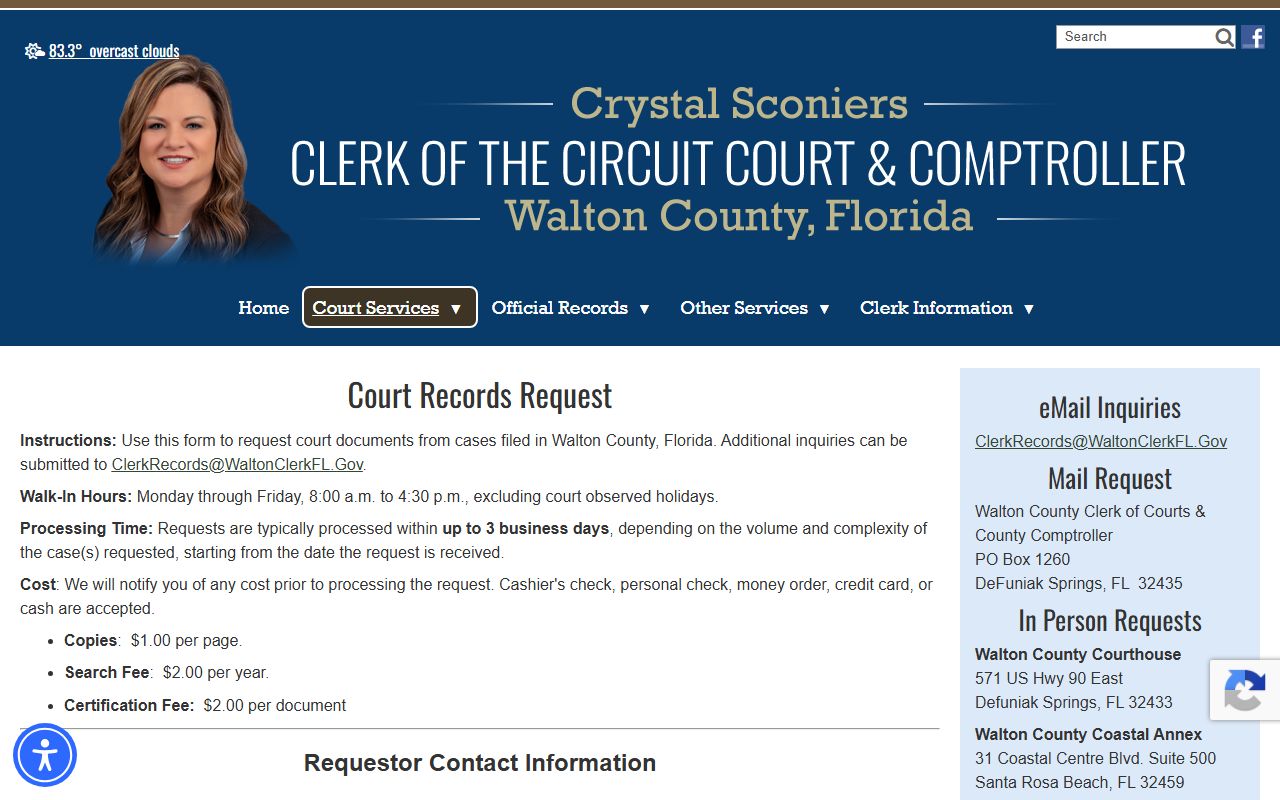
The form offers copies or certified copies and lists reasons such as immigration, licensing, and clemency. Requests can be emailed to the clerk or mailed to the DeFuniak Springs courthouse. Sealing and expunging an arrest record is covered above, and the booking side stays with the sheriff's roster.